Ensuring Debt Finance for All Professionally-run MSMEs.

For several years, a number of policy initiatives have been taken to address the financing gaps for MSMEs. Of course, we have improved over the years. However, a lot still needs to be done. Here is a set of views, that I have, on how to go about doing it. Some of it is about approach and some of it is about actual implementation. Of course, this is a complex problem and I am not denying that genuine efforts have been made in the past. My argument is that those efforts have fallen short and it may be a time for policy makers to do a few things differently (to the extent that some of the suggestions may seem impractical but I am taking the liberty to list them out here.)

Note: Unsecured, small ticket lending to MSMEs based on credit of the individual promoter is largely (on the How to aspect) a solved problem (in India) and has got/getting a lot of attention. (We are miles to go for universal access to finance for MSMEs even in the small ticket, individual credit led lending.) The focus of this write-up is on corporate SMEs with high growth aspirations, where the funding requirements is in crores (individual promoters credit is not a good alternative for company credit) and is generally not done by traditional lenders without mortgage collateral. For new age, asset light but professionally run businesses, it is a key gap, that remains unsolved at scale. Hence, the focus on that segment in this write-up.This write-up is addressed to those shaping policy and regulation. This write-up is specific to the Indian context.

Do NOT broad brush: The MSME segment includes not just the local tea shop, or the puffed rice making factory but also includes the SME corporate with turnover upto INR 250 Cr (as per the recommended Budget 2018 classification) with some of them having raised institutional venture capital. Hence, the funding requirement, credit evaluation process and lending model will not be the same. If we don’t separate out the sub-segments and find specific solutions for each segment based on loan size, security and nature of entity, we will not have a comprehensive solution.

It may make sense to break down MSMEs into categories based on legal structure i.e. individual, proprietorship, partnership and OPC or private limited and have priority sector or lending target setting done separately for them. Have caps on loan amounts for each type of legal structure. The reason why I say this is, I am not sure why a firm with several crores of rupees in turnover, borrowing from banks, etc in crores should have the legal structure of a partnership/proprietorship. It should be a private limited company. The regulators have to make it easier for people to set up companies and be compliant. This will enable access to additional sources of data which can be leverage to take lending decisions.

(A note for SMEs seeking larger loans: If you don’t have mortgage or collateral security AND you haven’t put in much of your money as equity because you don’t have much AND you don’t have reasonable size of operations AND you don’t want to be compliant with additional regulations or provide verifiable data on various aspects of your business AND you still expect funding in crores – time to get some coffee. The purpose of adding compliance and improving access to different sources of data from the SME is to deal with the lack of security. Please note that unlike equity investors, lenders do not get a share on your upside but they do get a share of your downside for sure and hence they need to ensure that downside is limited. )

Accept that only Banks will NOT be able to help us in ensuring complete access to finance for MSMEs: Banks hold public/retail deposits and it is natural that they will have less risk appetite than NBFCs or specialised funds who are typically funded by entities that have the ability to manage risk unlike the retail depositor of a bank. By design, NBFCs or specialised funds will take more risk through sectoral specialisations. Historically, banks have been treated as the favoured child by regulators. If there is genuine interest in enabling access to finance for all segments of MSMEs, it has to be recognised that banks, NBFCs, specialised funds will together be able to address the funding needs of MSMEs.

How about allowing specialised MSME lenders partial access to the payments and settlements system? This will allow them to set up basic escrow accounts and current accounts with zero or close to zero EOD balance and ability to receive funds ONLY from corporates. NO cheques, NO savings or other deposits. This will enable specialised MSME lenders/NBFCs to offer payments, set up escrows to do a cash flow traping arrangements to deduct repayments without having to depend upon banks who create severe roadblocks in letting specialised lenders access to these simple operations. Sounds, kind of, like payment banks but I am talking about larger value transactions. Say, those who offer loans in INR crores to corporate SMEs and need to transact in several lakhs and crores and not in thousands.

Use Govt backed DFIs as market developers: India needs to find a way to use Govt backed DFIs in a market development role and not in competitor role. Their role should be to find ways to encourage other commercial lenders/investors (Banks, NBFCs, specialised funds) to do the job of lending to MSMEs instead of competing with them by trying to reach the MSMEs directly. I understand that there was a time when DFIs had to “show the way” because the commercial lenders/investors were not interested. However, over the past 8-10 years, it has been shown that private entities have been trying to find different ways of reaching out to the lucrative MSME finance gap. Frankly, if all the banks and NBFCs together are not able to directly reach all MSMEs, it is good reason to introspect and accept that one or two DFIs with limited geographic presence can reach out to all MSMEs.

Policy makers should encourage the use DFI funds to act as market developers through guarantees/credit enhancements for institutional investors to invest into NBFCs/specialised funds that are trying to fund MSMEs in India. This opens up a much larger tap of borrowings for the NBFCs and specialised funds (beyond banks) and also enables them to raise funding at a cheaper cost (assuming credit enhancement by DFI will lead to better rating of the transaction.). Oddly enough, I have seen multiple instances where Indian DFIs offer funding to NBFCs/specialised funds at a cost that is signifcantly higher than what the commercial banks or offshore commercial and DFI lenders are ready to offer at.

Consider Bank, NBFCs and specialised funds as partners and not adversaries: Banks in India (DFIs included) do not like sharing of pari-passu or second charge with NBFCs or specialised funds, as a practice, when lending to SMEs. Even though nothing in the regulation or law disallows it. This is a version of caste system propagated within our financial services industry under the excuse of lack of sufficient assets. Interestingly, I have seen multiple cases of companies that are profitable for more than 3 years with INR 50 Cr+ revenues (and fixed and current assets worth atleast INR 15-20 Cr) having INR 2 Cr worth short term facilities from banks backed by 75% cash deposits and security over entire current and future assets of the company (and possibly even the kidney’s of the promoters) NOT willing to share pari-passu charge over receivables (not on cash, not on fixed assets, just receivables) for NBFCs willing to lend higher amount than the bank and under more flexible terms. Since, forced regulation and orders will not solve this “social” problem, a better way is to encourage banks i.e. say that for the MSME loan accounts that the bank has, if the banks are able to demonstrate another non-bank lender on-board, they will be awarded 1.5x the value of their loans as priority sector.

Over-leverage of SMEs has to be addressed differently: Initiatives like the central credit registry is necessary to give a clear idea about over-leverage.(This is already being done.) It should be made compulsory to have all types of financial lenders (not just banks) add the details of the loans on the platform.

Data, data, data: Enable electronic access to data for all types of statutory, regulatory and transaction compliance done by companies. Eg: Specialised lenders or even banks should have access to data on taxes, electricity payments, EPFO, ESI, salary, bank transactions, etc. Security and privacy concerns are paramount but given that they are solvable issues, we need to find ways in which access to all that data is made extremely convenient, if we were to expand access to finance for MSMEs.

“World Domination”​ of the Agri Supply Chain

Historically misdirected/misutilised subsidies of the Govt made it very difficult for private players to operate in the agriculture supply chain. With the easing of regulations, we are seeing a large number of new private ventures (traditional and new age startups) entering agriculture. That is a good sign.

However, what worries me is that some of these companies (startups) and their VC investors are looking at the agri supply chain “domination” game with a similar approach like the Uber/Ola/Flipkart/Amazon model of “world domination” by burning huge volume of money to deliver market distorting “subsidies” to capture market share with the hope that the last startup standing will win it all. (Remember the days when drivers and riders were being paid to ferry you around? Or deep discounted sales prices for products?)

While Uber/Ola/Flipkart/Amazon is still to prove business viability, they are already shifting gears and causing significant distress to the affected. It may be argued that they have distorted local transportation markets for riders (costs have gone up significantly and availability is still a major problem) and have left several drivers with debt burdens they can’t service. We don’t know how this will end. (Anybody who knows, I am ready to buy you a coffee.)

If the startups and VCs replicate the same model of “world domination” in the agriculture supply chain (particularly when dealing directly with the farmer), they will most certainly leave the agri ecosystem with much more pain and damage than what the Govt did with misdirected subsidies.

VC Associates and Partners with no special expertise or knowledge of agri markets but with boatloads of cash will continue to wear Rolexes purchased with fund management fees whether or not their invested startup works. Startup entrepreneurs with “game changing” ideas but no capability to build a profitable business or achieve frugal growth, will buy mansions in Koramangala or Lutyens and select the next “Entrepreneur of the Year”, whether or not their startup works. But the farmer will be stuck between the devil (Govt) and the deep sea (startups) after enjoying a brief period of money induced trance and exuberance.

I know some will agree with all that I wrote. Good to know. Let’s get some coffee and discuss more. I also know that some will disagree with all that I have written and say that I can’t see the “big picture” and worse I am a “communist”. True, I can’t see the big picture but atleast, I am not blind or a communist. Let’s get some coffee and see if you can help me see the “big picture” and if I can get your eyesight back.

What is it to have succeeded?

This quotation has been a long time favourite, thought I should put it up here. It is by Ralph Waldo Emerson.

To laugh often and much; to win the respect of the intelligent people and the affection of children; to earn the appreciation of honest critics and endure the betrayal of false friends; to appreciate beauty; to find the beauty in others; to leave the world a bit better whether by a healthy child, a garden patch, or a redeemed social condition; to know that one life has breathed easier because you lived here. This is to have succeeded.

Access to Finance for Financiers

dKXGkaWhile enough literature is available pointing out to the lucrative business (and impact) that local financial institutions could target by reaching out to the micro and small businesses in any economy, there is very little written about how these “local financial institutions” can access funding to re-lend to this segment underserved segment. By nature, small businesses are risky and lack of formally verifiable income makes it difficult for banks to lend to small business. To some extent, it is right that banks avoid getting into financing risky business at a large scale given that they risk putting retail deposits at risk in case they build a very risky loan book. This means that there is clearly a need to address the credit needs of smaller enterprises through a network of more nimble financial institutions. In fact, in India some specialised lenders have come up over the years catering to different types of small businesses. Such financial institutions are recognised by the Reserve Bank of India as well.

They reach out to the “lucrative” MSME segment through customised appraisal mechanisms and lending processes and often due to their close ground presence manage to have a fairly good quality of loan book. Higher risk is adequately compensated by higher yield AND additional measures like closer monitoring prevents high default rates. This makes it look like an attractive proposition for people who want to invest (as debt or equity) in such businesses. In fact, a lot of these business have got significant equity interest. And that is where it starts to get interesting.

They have an interesting problem of being able to raise equity while not being able to raise enough domestic debt. A clearer inspection would reveal that the equity raises have largely been from foreign sources and often result in companies facing hurdles around the guidelines that guide loss of shareholding vs FDI amounts invested.

While the debt could have also come in from offshore sources, bringing debt into India from foreign jurisdictions faces lot of obstacles in terms of process (which has become significantly smoother over the years but it still continues to be a pain). These small financial institutions depend largely upon banks for debt funding and banks in India don’t fund anything unless the borrower is large enough or unless they the borrower is classified as priority sector. If a corporate entity doesn’t fall into any of those categories, their growth expectations are doomed because banks just wouldn’t fund.

Of course, banks have their own reasons. Most of these small financial institutions would be less than investment  grade (as per rating agencies) or just about investment grade. “Risking” money in something that the rating agencies don’t call investment grade is criminal in a bank setup.What banks miss though is that there is a way to assess such companies by moving out of the branches and observing the operations of those companies, their people and their practices. A small group of debt funding companies (companies that I have worked for most of my career) understand that and provide funding to such small financial institutions based on strong/relevant evaluation practices. In my experience of working with such companies and debt funding of more than INR 9000 Crores, there has not been a single case of non performing assets, be it in the form of on balance sheet loans or in the form of off balance sheet transactions.

Beyond banks, we also have other sophisticated financial institutional investors who can measure and establish appropriate risk mitigation strategies but even they don’t because the size of funding that each individual small financial institution seeks is not economically interesting. Honest and successful efforts have been made by the organisations that I have worked with to bring larger investors to fund these smaller financial institutions but it still takes a lot of push to make such transactions happen. It is not the norm.

As a result, the growth of new small financial institutions which have the ability to cater to smaller enterprises and customers, enabling financial access for all have been very slow, painfully slow. Entrepreneur interest in setting up new financial institutions to reach out to smaller enterprises and households have waned in spite of all data/reports and literature suggesting that there is a large market to be addressed. The number of new NBFCs coming up in the Indian market have slowed down in the last 2-3 years. The only ones who continue to move ahead are the ones with significantly large equity backing. Crossing the Chasm before success is dependent entirely on equity.

A portfolio size of INR 100 Crores in portfolio outstanding seemed to be like something that could garner interest of banks. Such a portfolio size could also give rating agencies enough track record to consider a rating upgrade. It seems that the number is of INR 100 Crore in portfolio size is becoming less important now. It is more important to know how much of that INR 100 Crore is funding with equity because more often than not, debt wouldn’t be easy to get for such companies anyways.

In other words, bootstrapping as a strategy to enable access to finance for SMEs in India is a very challenging job! So, banks won’t fund small enterprises because they are small and risky and no body would fund those who can fund small enterprises because they are not large and not priority sector. How do we then make it easier for small enterprise to access debt in India?

Photo Courtesy: rgbfreestock

Also published on LinkedIn.

Enterprise and Quest towards reducing friction

Customer loyalty is a result of reduced friction.

All successful enterprises (for profit or non-profit) are in the business of reducing friction that a customer faces in the process of accessing  products or services required by the customer.

Friction, that arises during pre-product acquisition as well as post product acquisition phases, needs to be reduced to build customer loyalty. Successful enterprises strive to reduce friction during both phases.The expectation is that reduced friction in accessing a product or service will encourage the customer to be more willing to use only that specific enterprise as a source/channel, i.e. customer loyalty.

However, friction doesn’t get reduced in one go because it is not just the customer experience but also the customer mindset that is in play behind the decision of a customer to be loyal to an enterprise.

From a customer perspective, the willingness to use a particular channel/source follows a four step process as shown in the diagram below and in some ways, each specific sector/industry has evolved over the years following these steps. As an industry matured, successful enterprises within the industry had to take a step upwards to remain in the fray. Those that could not, fizzled out.

snowflake

Steps towards low friction.

The first step is continuity i.e. being available “forever”. A customer will not invest time and effort to understand how the channel enables him to access the product or service unless the customer is certain that the channel will continue to be available for a significant period in future. Eg: Continuity is a feature of public sector undertakings and is often a default choice for many people.

Predictability is the next level. Predictability is the certainty the enterprise will be able to provide you with the service/product at an expected point of time or as per an expected schedule. Predictability is also the certainty that the product or service will have a set of basic characteristics that the customer expects. Eg: If you require to pick up a coffee at a local store everyday on the way to office and you realise that it is not certain whether it will stay open, would you depend upon it or look for an alternative before that?

Continuity and Predictability together build a sense of Reliability in the customers’ mind.

The next step  is convenience i.e. being available at a point of time, in a form and at a place that meets the customers’ requirement to the best possible extent. An enterprise can meet all three requirements or aim to achieve at least one of the above to be considered a convenient channel. Eg: Bigbasket.com gets you groceries at your place, at an expected time slot and the products are generally fresh! Many who have started using it, often don’t give up.

Beyond convenience is the flexibility offered by an enterprise. Flexibility in terms of product/ service options that meet specific needs of each individual customer and/or the ability to modify the choice during the process. Eg: Flipkart lets you return without any questions asked!

Convenience and flexibility are bring about a sense of Ease of Access in the mind of the customer which builds stickiness or customer loyalty.

Reliability and Ease of Access need different approaches.

Interesting thing about the aspects of Reliability and the Aspect of Ease of Access is that the ability to rely varies widely with the mindset of the customer (within the same customer profile) but the ability to perceive ease of access is quite democratic within a similar customer profile.

All new enterprises need to identify a set of early adopters who have the mindset to rely upon the enterprise more easily than the majority population. If the early adopters are satisfied, the word of mouth will enable the late adopters to start believing in the enterprise ability and move over. While it is difficult for the late adopters to easily rely, once a late adopter joins, it is not very difficult for the late adopter to see the value of Ease of Access.

In fact, ease of access is something that is often the most visible aspect and often a part of the sales pitch of the enterprise. Reality is, the customer needs to cover the first two steps before they can get the benefit of ease of access and the first two steps is more about the customers’ mindset that what the product offers.

So, while it takes a lot of effort to build a perception of reliability, a perception around ease of access is built easily. Similarly, it is easier to change perception with regards to ease of access than with regards to reliability.

It must be noted that Reliability is fundamental to the success of the enterprise. An enterprise can fight it out if it is reliable but doesn’t offer ease of access. However, it is impossible for an enterprise to survive if it offers ease of access but doesn’t offer reliability.

How does an enterprise provide Reliable and Easy to Access products/services?

As an industry matures and more enterprises join the fray, management of the issues that help in building the first two steps get fairly commoditised i.e. earlier, services/products that met the basic first two steps used to have economic value and used to be distinguishable but with more competition, they end up losing differentiation and hence lose the ability to build customer loyalty. The result is that in addition to Reliability, Ease of access becomes critical to the ability of the enterprise to command margins and survive in a mature (competitive) market.

Co-ordination (between different supply chain actors) or innovation (technology or process)enables the enterprise to provide better ease of access. The ability of the enterprise to work on these two aspects while keeping the customer shielded from the brisk activity in the back-end by providing an interface that cancels out all the noise (of co-ordination/innovation) is what reduces friction and builds customer loyalty.

Models of Charity

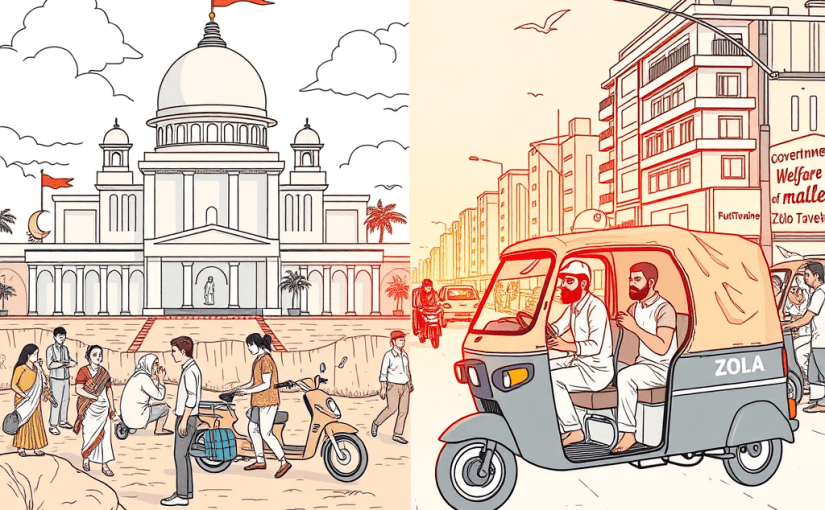
On a different planet called Vrithpi, two models of welfare for lower income Households (HH) were observed. Govt Led and Private Sector led. Which of the two (explained below) do you think is better? (The currency on that planet is called Rx)

Model 1 (Govt): In some rural locations, under the ONREGA scheme of the Govt low income people get paid Rx 120 for a day’s work and they get subsidised food that costs you Rx 20 a day under a group of some other Govt schemes. So, people work for a day and take rest for 5 days and then seek work again.
The govt raises debt from the market through govt securities to fund the payments. To repay the debt, the Govt taxes the salaried people and charges a cess on those who spend, for consumption of services or products. So, the honest tax payer loses money to feed the lower income HHs.

Model 2 (Private): In Bhaiderabad of Vrithpi, Zola Travels pays each auto  rickshaw driver (I am sure they have similar schemes for cab drivers) Rx 30 for each ride in addition to the metered fare that the rider pays, which is generally Rx 10 more than the meter. Zola also pay Rx 50 per day if they make three Zola trips during the day. So, the low income earner auto rickshaw driver, works only for Zola trips and let go of other trips unless the riders offer atleast Rs 40 more than the meter (which is often already tampered with).
To fund the Rx 30 and 50 Zola raises equity from fat pocketed Private Equity (PE) investors and sells them the story of long term market share and benefits of short term losses for long term windfall gains. But windfalls are rare. NAmazon sold the same story to public when they got listed 15 years ago and they still dont make money. So, the filthy rich PE guys lose money to feed the lower income HHs.

While both lead to market distortions and lower productivity, Zola Travel reduces income inequality in a very novel way by taking money away from the filthy rich. But what does the Govt do? It takes the wind out of the sails of only the salaried. So, which is a better model of welfare?

Oh wait, somebody very rightly pointed out that these PE guys don’t just “invest” the money of the filthy rich. They actually do get funded by large pension funds who who get money from salaried individuals (again!) and that money is meant to be the cushion when, due to old age, the ability to earn recedes.

What do they smoke in Vrithpi?

[Please Note: Any resemblance with anyone living or dead on Earth is unintended and a co-incidence. These models are not seen on Earth.]