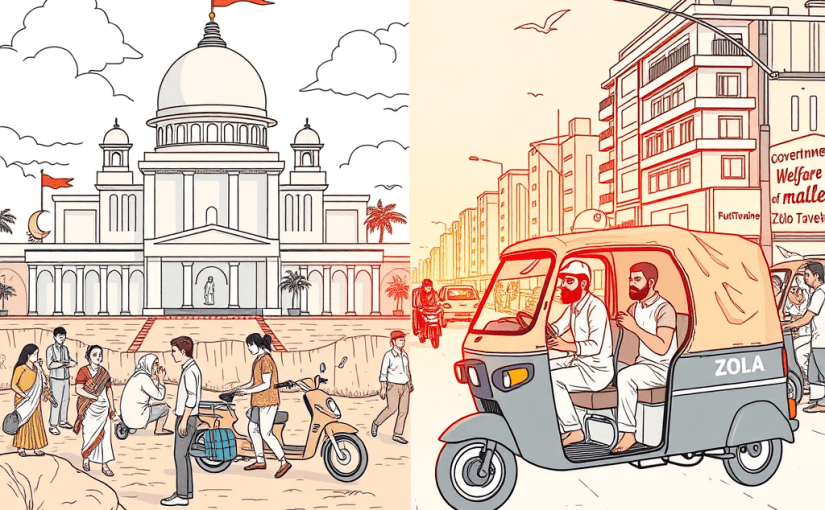
Models of Charity

On a different planet called Vrithpi, two models of welfare for lower income Households (HH) were observed. Govt Led and Private Sector led. Which of the two (explained below) do you think is better? (The currency on that planet is called Rx)

Model 1 (Govt): In some rural locations, under the ONREGA scheme of the Govt low income people get paid Rx 120 for a day’s work and they get subsidised food that costs you Rx 20 a day under a group of some other Govt schemes. So, people work for a day and take rest for 5 days and then seek work again.
The govt raises debt from the market through govt securities to fund the payments. To repay the debt, the Govt taxes the salaried people and charges a cess on those who spend, for consumption of services or products. So, the honest tax payer loses money to feed the lower income HHs.

Model 2 (Private): In Bhaiderabad of Vrithpi, Zola Travels pays each auto  rickshaw driver (I am sure they have similar schemes for cab drivers) Rx 30 for each ride in addition to the metered fare that the rider pays, which is generally Rx 10 more than the meter. Zola also pay Rx 50 per day if they make three Zola trips during the day. So, the low income earner auto rickshaw driver, works only for Zola trips and let go of other trips unless the riders offer atleast Rs 40 more than the meter (which is often already tampered with).
To fund the Rx 30 and 50 Zola raises equity from fat pocketed Private Equity (PE) investors and sells them the story of long term market share and benefits of short term losses for long term windfall gains. But windfalls are rare. NAmazon sold the same story to public when they got listed 15 years ago and they still dont make money. So, the filthy rich PE guys lose money to feed the lower income HHs.

While both lead to market distortions and lower productivity, Zola Travel reduces income inequality in a very novel way by taking money away from the filthy rich. But what does the Govt do? It takes the wind out of the sails of only the salaried. So, which is a better model of welfare?

Oh wait, somebody very rightly pointed out that these PE guys don’t just “invest” the money of the filthy rich. They actually do get funded by large pension funds who who get money from salaried individuals (again!) and that money is meant to be the cushion when, due to old age, the ability to earn recedes.

What do they smoke in Vrithpi?

[Please Note: Any resemblance with anyone living or dead on Earth is unintended and a co-incidence. These models are not seen on Earth.]

MUDRA Bank – How will it help?

First things first, a regulator cum re-financier (market player)  is bad design. Period. It leads to moral hazard where the regulator will shape policy to grow only its business. Yes, refinance is business.

But I hear that MUDRA Bank is expected to be a regulator and financier of microfinance institutions and micro-enterprises. Why?

The only other entity with such an entitlement, the National Housing Bank (which is a regulator and refinancier for Housing finance companies and bank housing loans) is expected to lose that status once the long pending NHB Bill is passed in its current form. The bill aims to move the regulatory powers of the NHB to the RBI and let NHB continue to operate as a sector focussed bank like NABARD and SIDBI. Obviously, the law makers realised that regulation and business do not go hand in hand.

That brings me to the second question, NABARD refinances MFIs, so does SIDBI. SIDBI refinances/ guarantees small/micro enterprise finance. So, basically, between the two they pretty much already do what the MUDRA Bank is supposed to do on the refinance side. So, why do we need a MUDRA Bank?  Yes, they don’t regulate. So, to regulate?

When the microfinance crisis broke out, there were discussions of NABARD being made a regulator for the MFI industry but that did not happen, primarily due to the fact that NABARD was actually a refinancier (a service provider) for MFIs and the significant majority wanted NABARD to continue as a service provider and not become a regulator in parts due to the lack of infrastructure and in parts to avoid the moral hazard issue. The only reason why NABARD was brought into the picture was microfinance institutions not only included the RBI regulated NBFC-MFIs but also societies and trusts not regulated by he RBI.  However, NABARD felt that they did not have some of the “missing links to operate in the sector” as a regulator.

What then, will the MUDRA Bank do differently? If the several decade old and experienced NABARD thinks they can’t handle the job, how will the MUDRA Bank manage?

Another interesting proposed change is that the FMC and SEBI are going to be merged, the logic seems to be that financial and commodity markets are, at the end of the day,markets and hence they should have a common regulator because this will streamline decision making and potentially trigger new products. Great!

And there comes my third question, why then are we trying to create multiple entities for microfinance and enterprise finance? Where is the coherence in “strategy”?

Instead of seeding new ideas, would it not be better to energise the NABARD and SIDBI to take the word “Development” in their names seriously for their respective sectors? To adopt innovation and  shake away  some of the bureaucracy that binds them down? To adopt proactive measures to tackle the problem of access to finance for small businesses?

And please, for the sake of humanity, why should a bank promoting entrepreneurship favour only the scheduled castes and tribes? Favour all enterpreneurs, if you can. Nobody does that in our country.

(Edited on 9th March, 2015 to add an article on the same topic by noted journalist/author Mr. Tamal Bandyopadhyay. He seems to point out similar concerns.)

Whose responsibility is it to make one “job-ready”?

The industry cribs all the time that Indian education doesn’t produce enough job-ready people. I wonder, is it the responsibility of the schools/colleges to make one job ready by training them on specific tasks? Or is it the school/college’s responsibility to provide the students with the general tools and knowledge of theories and practices that will help when they take up a job. No school/college ever knows what job each of its students will take up. So, it is not possible to train the students on specific tasks! It is fair that they impart training that is general in nature. And, it is obvious that such general training may not be useful for specific employers.

The employers have all the specific processes and equipments that can be used for demonstration and making the new entrant job-ready for that specific job. Only employers can provide this customised training required to make the best job fit. So,  shouldn’t the employers be training them? Are the employers shirking responsibilities? Do all the employers in our country today have customised training for their new recruits/staff?

Standard Reply: The employers fear that whoever they train will soon escape to some other employer and so they don’t want to invest. Really? So, the alternate solution is you crib and take in half trained people and use them immediately to deliver services and products which are equally half baked?

Is trainee/apprenticeship period for training new recruits and making them job ready? Or is it a few months when the new recruit is like any other experienced employee, expected to deliver but at a lower cost and with the flexibility to be fired at short notice?

(Views of an outsider who is very much a part of the story.)

Will the on-demand economy lead to skewed availability of essential services?

a little bit ofOn- demand economy businesses (like say über, Elance, etc) do the great thing of connecting idle resources with those who need them, whenever they need them and all of this at a reduced or nil search cost.  So, on-demand economy platforms/marketplaces enable better utilisation of resources and improve overall efficiencies.

While most people normally prize certainty of income more than “freedom” from fixed long-term contract, there are some who do not want to be tied up in a fixed long-term contract. They prefer to take up a short-term engagement to provide their services as per the opportunity given to them by the on-demand business platform and continue to earn without having to bother getting the fixed long-term contract. Unfortunately, such elite groups are few in this planet and are usually comprised of people whose basic needs are already met from some other source. Such people stand to gain from the on-demand economy as well.

This means that the on-demand business model essentially leverages the marginal cost concept to make service available on a marginal cost basis instead of the marginal plus fixed cost that a user would typically incur when taking services from a service provider organisation that employs people under long term  contracts to provide the services. So, not  unusually, the services provided by on-demand service providers is often cheaper.

However, the benefit of the on-demand economy is when an “idle” resource is utilized. Meaning that, somebody who is otherwise employed with a full time employer (an employer that pays for his employee benefits and social security) is interested in offering his services in his free time to earn additional money to support his needs. The additional earning is expected to satisfy only incremental needs because basic needs and social security are already taken care of by the full time employer. Hence, he is able to offer his services at a cheaper cost than what his normal hourly rate would be with his employer.

Now, if this on-demand business platform works efficiently, his employer, who is currently paying for his social security as well as his marginal cost of services, might wonder if they should cut costs and take the services of somebody from the on demand business platform at a lower cost where the employer will just be paying for the services and not be paying for the social security.

Imagine a world where all employers or all people who need services think that  on-demand is cheaper and more efficient and hence they should all go the on demand way for all types of services.

Two situations can arise because of everybody moving to on-demand service platforms for getting things done:

Situation 1: Since there is nobody to pay their social security, the on-demand service providers will hike their charges per service to meet their social security needs and since they are now not sure of getting the next order/request for service, they will charge an additional premium to safeguard themselves. Which means the cost of each service will go up and the people who were earlier able to afford the on-demand service because it was cheap are now unable to get the service. Moreover since, everybody has moved on to provide on-demand service, there is nobody who can provide service even at the earlier affordable cost provided by the full time employers. Only the rich few can now afford a service which was affordable to many.

Situation 2: The competition keeps on increasing and on-demand service providers are unable to hike their charges because there is always more people ready to offer their services than there is demand. Hence, nobody pays for their social security.

Both situations are extreme and dangerous. But, both situations are possible in pockets depending upon local market conditions. The world is not perfect, it has a knack of amplifying the negatives in any good thing and so it will amplify the negatives in the on-demand model as well. Till we have a perfect world (!), we need to take caution to avoid the situations mentioned above but let us not stop walking. We need to appreciate the shortcomings of on-demand from the perspective of a more balanced world and take appropriate measures. Is the Govt listening?

On-demand economy businesses is great thing but we must find a way to avoid a situation where the entire world/ or a majority shifts to on-demand ways. We will then have a world full of informally employed where income is never guaranteed but is highly variable. Not everybody can handle the variability. Not every situation (say illness) a person faces can withstand the variability and that is why we value certainty of a job more than informal income. That is why we value full time employment more than contractual labour. That is why we value affordability of basic services.

Fact is,  on-demand services are a stylised version of contractual labour which has seen its share of criticisms because of the uncertainty that it brings to the lives of those who provide services and the lack of responsibility that it lets organisations live with. It creates a dis-balance in the garb of increased efficiency.  Contractual labour had negatively affected the lives of those providing the services. Unrestrained growth of On-demand in its current form threatens to affect both service providers and the customers of the service, unless a counterbalancing innovation/policy is found.

Credit Scoring Vs Personalised Lending

In India, all banks have internal credit scoring models and it has not helped them in lending to SMEs.

Two key reasons why banks (formal lending institutions) do not lend to SMEs in India are
a.) Lack of information on actual profitability/cash flows. No official documented evidence of income can be found. This is primarily in keeping with practice of dealing in cash, belief in oral contracts and mostly absence of contracts (sale/purchase) altogether. In addition, the myopic tendency to avoid taxes leads to minimal documentation or under-reporting of incomes. If no concrete data is found, what do the bank feed into their credit scoring models?

b.) Small ticket size and hence high operating expense per loan. Ideally a credit scoring model reduces the high opex of small loans by taking an automated call on whether to do a loan or not without having a credit person go through the case in detail as he is expected to do in larger loan ticket sizes. But, then, for these kind of small loans with no concrete data, what does one feed into the credit scoring model? Subjective evaluations of the credit appraising officer?

It is undisputed that the effectiveness of a credit scoring model is dependent upon the quality of data being fed. However, since the quality/reliability of data that is available to be fed into the credit scoring model is poor and subjective, especially in case of SMEs in India, how does one use a credit scoring model? In fact, due to high level of subjectivity, the data being fed into the credit scoring model can jeopardise the credit scoring techniques.

Credit scoring models can speed up process but they can not replace personalized diligence based lending till the time good data is available. There is barely any electronic footprint left by SMEs that can be dug up for credit analysis. The bank account (if available) details wouldn’t show enough balance, their transactions would be fairly thin. Understood that visiting the customers for a small ticket size loan results in high opex but in the case of SMEs where transactions are primarily cash based, expecting to lend to customers in the SME segment without meeting the customers, suppliers, buyers of the SME and without visiting the location is a recipe for disaster.

A few new age lenders are depending upon use of surrogates/proxies for assessment of actual cash flows, followed by close monitoring of loans. They depend exceedingly on customer visits. Their portfolios have performed well but yes, it is too early. While it is not free of subjectivity, this approach seems to be better than that of large banks who use an inflexible credit scoring model based on documented data. I agree that the rate of growth in such kind of specialized lending may not be as fast as mainstream financial institutions till the time sufficient electronic footprint is generated by the target SMEs. Meanwhile, using some form of credit scoring models in parallel can add a layer of check over the existing rigorous personalized appraisal procedure. This helps in reducing the impact of subjectivity in the personalized lending processes.

Credit scoring models are needed. The critical question that we need to answer today is, how do we improve the quality of data available to be fed into credit scoring models? If not immediately, how do we build the right data backend that provides high quality data in the future?

According to me, this kind of data backend will have two components, one that deals with general data points which can be used for bench marking and two that deals with individual specific data points that further become a part of the general database:

a.) Benchmarking: A good data backend can actually be a like a platform where location specific details on various businesses and margins are fed by staff of lenders. Over a period of time and volume, these numbers will give adequate guidance on the claims of margins/profitability made by the potential borrowers. Once the coverage of data collection efforts improve with time credit scoring models can play a better role.

b.) For individual evaluation: Individual credit/liability histories need to be pushed into this data back-end. Electricity bills, mobile phone bills, credit bureau details, need to be automatically fed or fed based on requests. The question is will the respective companies share data? Will a mobile company share prepaid recharge data of a customer?

Once this is done over a period of time, I believe a credit scoring model will start making more sense for SME lending in India. However, ditching personalized lending altogether, would continue being a distant dream for a fairly long time, if not for ever.

The approach can not be Credit Scoring VS personalized lending. The approach instead has to be Credit Scoring AND personalized lending.

Payments in remote locations

Payments to dairy farmers in residing in rural remote locations is made primarily in cash across India. Every week/fortnight, the milk collection van brings in a cash box and pays the farmers the price of milk bought since the last payday. In some cases, the payment is daily.

Experience revealed that in making payments to farmers through this route, the cashier handing over the cash often held back some amount of money as a “commission” or out of plain rowdyism. The cashier/ accountant would in a lot of cases be the favourite man of the secretary of the collection centre (society) or the secretary himself. The helpless farmer would then have to part with a fraction of the money due to him to make sure s/he doesn’t rub the powerful cashier the wrong way.

Some milk buying companies thought of a novel way of eliminating this problem. They started paying the money directly to the bank account of the farmer. The bank account was especially opened for this purpose. So, the cashier is no longer able to play foul. But, on every payday, the farmer has to abandon work (which means loss of a day’s wage or agriculture) and go to the bank branch which would be in a “nearby” town, some 15-20 kms away. He incurs travel expenses as well. The money has to be drawn out immediately because the farmer needs the cash to buy daily items like groceries, medicines, etc. There is no other source of cash income that is as regular/frequent as dairy. Moreover, much to the disgust of the bank manager in the town, there would be a long queue of dairy farmers waiting to draw their money on every payday leading to a tremendous rush in an otherwise quiet (and understaffed) bank branch.

The innovative milk buying companies understood this problem as well and figured out a solution. They handed over bio-metric cards to the dairy farmers for each bank account and got an “agent” tied to a third-party payments company to hand deliver the cash at the doorstep of the farmer. The agent carried bags of cash to the village and after bio-metric authentication hands the cash over to the farmer at the doorstep. But then, after a few months the agent starts charging commission, lesser than the cashier/secretary in the first situation but charges some amount. The bio-metric account reads that the farmer has drawn the entire amount of money. Though this agent works with a “private” company with greater accountability, the farmer agrees to let go of the amount because otherwise he will have to travel all the way to the bank.

We are back to square one and possibly in an even worse situation. In the earlier case, the cash was sent to the remote village in a milk truck with at least two persons on board. Not an ideal situation but it was better than what we see in this system. In this system, the “agent” typically hops on to a motorcycle with the bag of cash picked from a local bank branch and rides all the way to the villages. A few agents get robbed on the way. In fact carrying a few lakhs of cash does not turn out to be a safe thing to do. But there is no other way. Cash in transit insurance saves the day for some milk buying companies but some agents get killed.

Where does this end? “Mobile money” some people say. However, till the time the local grocery shops start accepting payments through mobile phones, how will mobile money transfer be of any use?

How have these risks been handled in India and outside? What are the examples of payments in remote locations seen in other parts of the world? What kind of supporting infrastructure is required to enable a safer payments situation?

(Also published on LinkedIn.)

Next…what?


Renewable Energy.

Water.

Medical Technologies. (Detection and treatment)

Agriculture.- Food production & Food preservation.

That is where breakthrough innovation is required. We will possibly see breakthrough innovations in these areas (in that order) in future. Something similar to what we have seen in case of communication technologies over the past decade.

While Renewable Energy and Medical Technologies have received venture investments, Agri-Tech and Water are still to see mainstream venture capital investments.

Reading List- 23rd Nov, 2013

1.)What if your memory is fake?

Article: Fake memory

Those people who seem to have a photographic memory might just be having a fake memory!

2.) A brilliant innovation gets you fit for the Olympics!

Video: Subway tickets

3.) The story of Mike Tyson. Told again.

Article: Mike Tyson

4.) How Amazon became an everything store

Article: Amazon

5.) Why does airline food suck?

Article: Airline food

Boredom and Low humidity are two key reasons along with constraints in preparing food in the air. We lose sense of taste/flavour due to a blocked sinus and low humidity. This makes us less perceptive of the taste. Interestingly, Indian food is less affected by these conditions due to the fact that naturally permits humid sauces in its preparation.