
Today is Vishwakarma Puja – a festival in India celebrating Lord Vishwakarma, the divine architect and patron of craftsmen, engineers and tools.
At the dairy technology college where I did my B. Tech., it meant cleaning and decorating the workshops and equipment, worshipping them, and, students making dairy products and serving them free to visitors.
And visitors there were. The entire campus, plus much of the surrounding neighbourhood, would turn up. Nearly 1,000 people. If not more.
For years, the tradition had been to make flavoured milk. People happily came back for multiple servings.
The feedback was usually: “It makes me gassy, but it’s delicious, and it’s free!” 😂
Whether the gassiness was simply from lactose intolerance, something that is relatively common in India, or because we weren’t processing the milk quite right, remains a mystery.
That year, it was our batch’s turn.
I suggested: Why don’t we make flavoured lassi, the stirred, sweetened yoghurt drink?
It was a different product and fermentation might make it easier to digest for people with lactose intolerance.
There was just one small problem. We had absolutely no equipment to make lassi at that scale.
We had no proper system for dosing the starter culture, the bacteria that turn milk into curd, and no incubation chamber to allow the curd to set.
Fortunately, we had some “expert” help. Some fourth-year seniors had just returned from their fourth year in-plant training. A few had trained at lassi manufacturing plants and generously offered to help us dose the culture manually.
We set aside 300 litres for lassi and another 200 litres for flavoured milk as a backup.
Then came the bigger problem:
How do you keep the milk warm enough for the curd to set?
We didn’t have an incubation chamber. And we were using thermophilic starter cultures, commonly used in industrial yoghurt production, which prefer relatively high temperatures.
We did have a newly completed cold storage room at the student dairy plant.
Yes. A COLD room. So we put halogen lights inside it.
The insulated “cold” room trapped the heat from the lights, creating a surprisingly effective warm chamber for setting the curd.
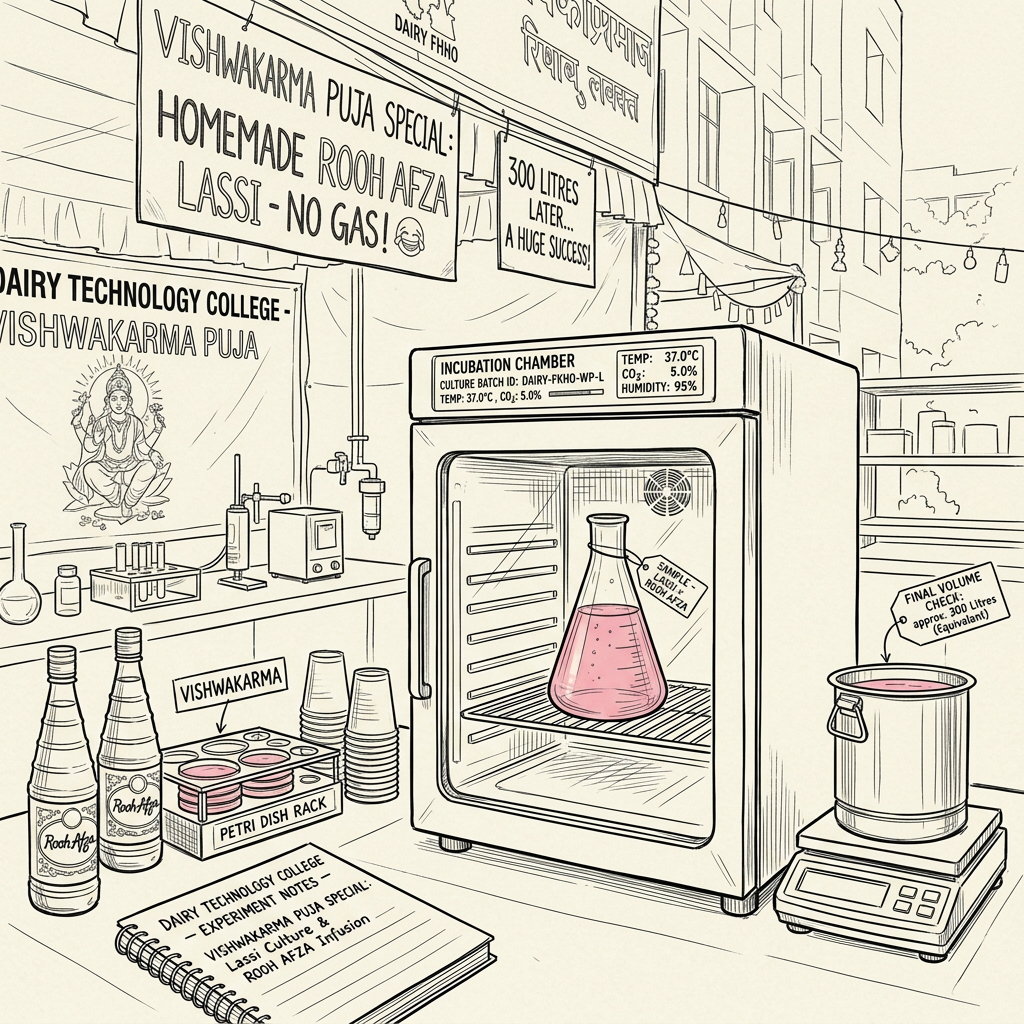
Then we waited.
If the curd didn’t set, our lassi plan was over. We would have 300 litres of very expensive disappointment. And I would have had to explain why I had helped waste it.
The next morning, we opened the cold room.
Perfect curd. Huge relief.
We stirred the curd into lassi, added Rooh Afza, filled cups and stocked them in refrigerators.
Then we started serving. “No gas!” was the verdict this time. 😂 People loved it and most had multiple glasses till we chased people away.
Somehow, my association with lassi continued long after that.
I did my Master’s in Dairy Chemistry, with a minor in Microbiology. My thesis was on how carrots could affect the chemistry of lassi. But that’s a story for another time.
Happy Vishwakarma Puja!
Discover more from Avishek Gupta
Subscribe to get the latest posts sent to your email.


